From text to a frame
The text system shapes and lays out text with Parley, rasterises glyphs on the CPU into an atlas, and draws them through wgpu. Font selection, shaping, glyph rasterisation and GPU drawing are separate stages.
In components, the element tree lays out a block’s inline content (text and elements such as strong, em and code) as one Parley layout and draws it with the same pipeline. Elements and events lists the text properties it reads and the cases it refuses.
The framework bundles Geist and Geist Mono. Desktop builds can fall back to system fonts after the bundle. The browser has only the bundle at this revision; a character it does not contain draws the missing-glyph shape. Fetching additional fallback fonts is later work.
What the comparison shows
The framework repository includes a comparison image captured on Debian 13 against Chromium 155. Each scale row places vapors on the left and Chromium on the right, with light-on-dark and dark-on-light panels.
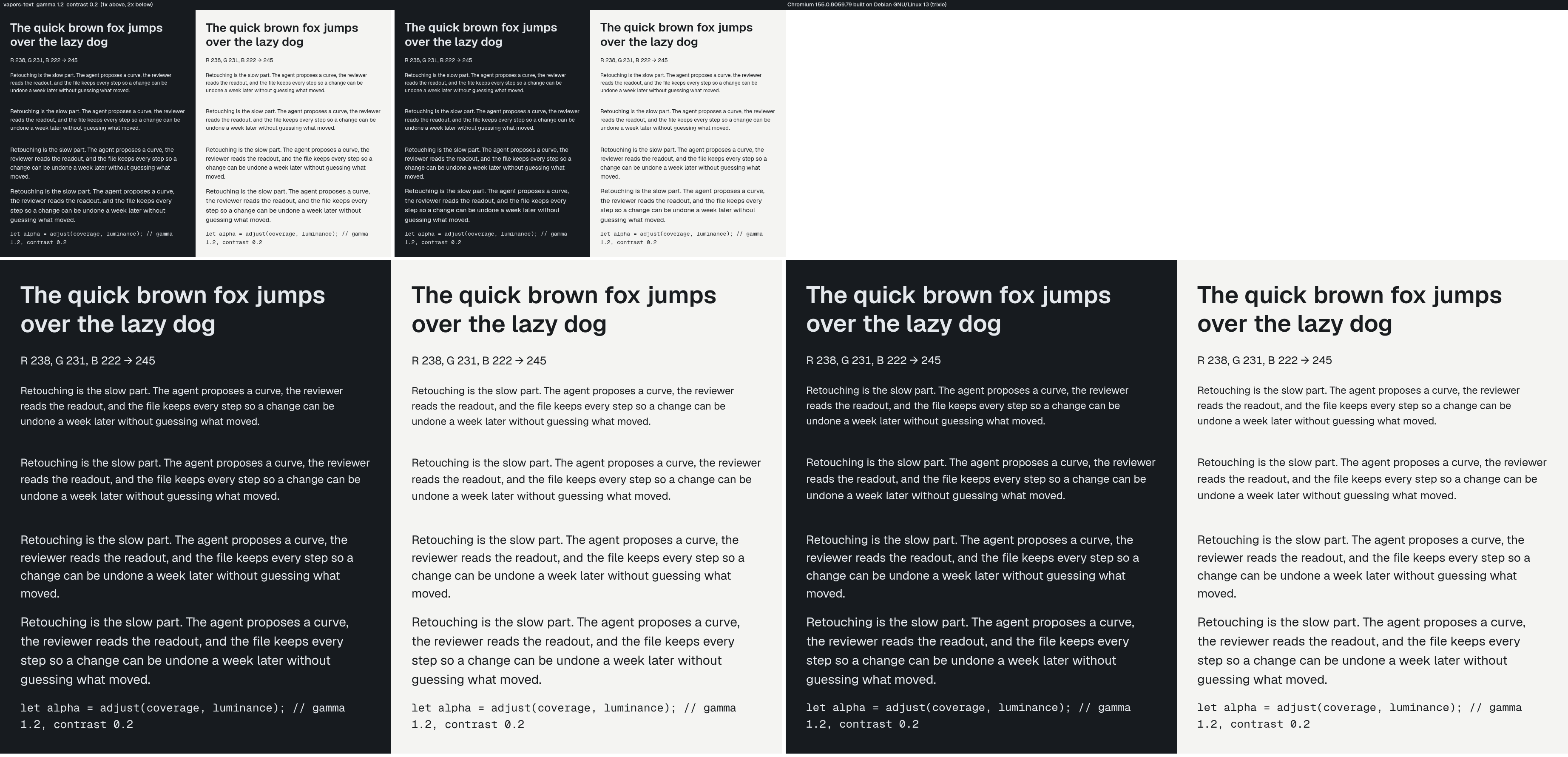
The comparison measured each block’s mean ink against Chromium. The recorded gamma and contrast settings put those blocks within 3% on that run. That measurement describes the captured configuration; it does not establish pixel equality or performance on other platforms.
Glyph caching
Rasterised glyphs are cached by font, size, variation, subpixel step and hinting. The atlas retains glyphs used by the current frame and evicts unused glyphs when it needs space. An upload to the GPU copies only the rectangle around the glyphs added since the last upload, or a whole page when it is new or was repacked. A frame that cannot fit is refused with the page size and the corrective action.
Colour emoji are deferred. The existing colour-glyph atlas page is not proof of a working colour-emoji path.
Reproduce the comparison locally
From the pinned framework checkout:
cargo run -p vapors-text --example text_comparison -- --out targetThe command writes separate captures and a labelled composite. It needs a working GPU path and Chromium. The framework text guide names the font versions, parameters, measurements and test limits.